Thursday, 19 June 2014

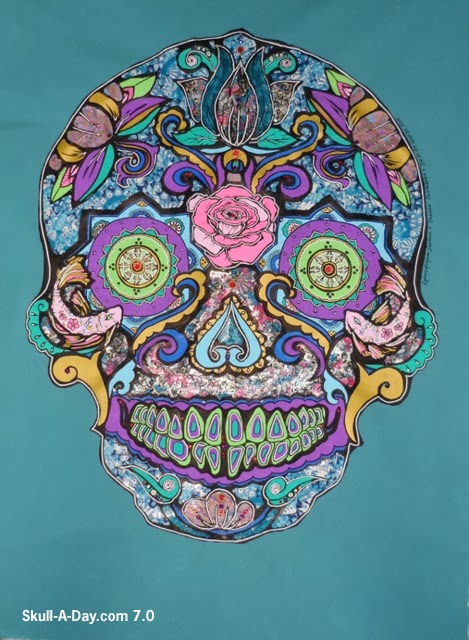
Featured on Art Slant! Yay!

Okay...it was a little while ago but we have just seen it here and it made us happy!

Friday, 6 June 2014

Respect to: The Almighty Frida Kahlo de Rivera


Frida Kahlo de Rivera (July 6, 1907 – July 13, 1954; Magdalena Carmen Frieda Kahlo y Calderón) was a Mexican painter, born in Coyoacán.  Perhaps best known for her self-portraits, Kahlo's work is remembered for its "pain and passion", and its intense, vibrant colors. Her work has been celebrated in Mexico as emblematic of national and indigenous tradition, and by feminists for its uncompromising depiction of the female experience and form.


Mexican culture and Amerindian cultural tradition figure prominently in her work, which has sometimes been characterized as Naïve art or folk art.  Her work has also been described as "surrealist", and in 1938 one surrealist described Kahlo herself as a "ribbon around a bomb".

Kahlo suffered lifelong health problems, many of which stemmed from a traffic accident in her teenage years. These issues are reflected in her works, more than half of which are self-portraits of one sort or another. Kahlo suggested, "I paint myself because I am so often alone and because I am the subject I know best."  She also stated, "I was born a bitch. I was born a painter

Frida was one of four daughters born to a Hungarian-Jewish father and a mother of Spanish and Mexican Indian descent. She did not originally plan to become an artist. A survivor of polio, she entered a pre-med program in Mexico City. At the age of 18, she was seriously injured in a bus accident.


She spent over a year in bed recovering from fractures to her spine, collarbone and ribs, a shattered pelvis, and shoulder and foot injuries. She endured more than 30 operations in her lifetime and during her convalescence she began to paint. Her paintings, mostly self-portraits and still life, were deliberately naïve, and filled with the colors and forms of Mexican folk art. At 22 she married the famous Mexican muralist Diego Rivera, 20 years her senior.


Their stormy,passionate relationship survived infidelities, the pressures of careers, divorce, remarriage, Frida's bi-sexual affairs, her poor health and her inability to have children. Frida once said: "I suffered two grave accidents in my life…One in which a streetcar knocked me down and the other was Diego." The streetcar accident left her crippled physically and Rivera crippled her emotionally.

During her lifetime, Frida created some 200 paintings, drawings and sketches related to her experiences in life, physical and emotional pain and her turbulent relationship with Diego. She produced 143 paintings, 55 of which are self-portraits. When asked why she painted so many self-portraits, Frida replied: "Because I am so often alone....because I am the subject I know best."

In 1953, when Frida Kahlo had her first solo exhibition in Mexico (the only one held in her native country during her lifetime), a local critic wrote:

"It is impossible to separate the life and work of this extraordinary person. Her paintings are her biography."

This observation serves to explain why her work is so different from that of her contemporaries. At the time of her exhibition opening, Frida's health was such that her Doctor told her that she was not to leave her bed. She insisted that she was going to attend her opening, and, in Frida style, she did. She arrived in an ambulance and her bed in the back of a truck. She was placed in her bed and four men carried her in to the waiting guests.

Both Frida and Diego were very active in the Communist Party in Mexico. In early July 1954, Frida made her last public appearance, when she participated in a Communist street demonstration. Soon after, on July 13th, 1954, at the age of 47, Frida passed away.

Once when asked what to do with her body when she dies, Frida replied: "Burn it…I don't want to be buried. I have spent too much time lying down…Just burn it!"

On the day after her death, mourners gathered at the crematorium to witness the cremation of Mexico's greatest and most shocking painter. Soon to be an international icon, Frida Kahlo knew how to give her fans one last unforgettable goodbye. As the cries of her admirers filled the room, the sudden blast of heat from the open incinerator doors caused her body to bolt upright. Her hair, now on fire from the flames, blazed around her head like a halo. Frida's lips seemed to break into a seductive grin just as the doors closed. Her last diary entry read: "I hope the end is joyful - and I hope never to return - Frida.".


Her ashes were placed in a pre-Columbian urn which is on display in the "Blue House" that she shared with Rivera. One year after her death, Rivera gave the house to the Mexican government to become a museum. Diego Rivera died in 1957. On July 12th, 1958, the “Blue House” was officially opened as the “Museo Frida Kahlo”.

Frida has been described as: "…one of history's grand divas…a tequila-slamming, dirty joke-telling smoker, bi-sexual that hobbled about her bohemian barrio in lavish indigenous dress and threw festive dinner parties for the likes of Leon Trotsky, poet Pablo Neruda, Nelson Rockefeller, and her on-again, off-again husband, muralist Diego Rivera."

 
Today, more than half a century after her death, her paintings fetch more money than any other female artist. A visit to the Museo Frida Kahlo is like taking a step back in time. All of her personal effects are displayed throughout the house and everything seems to be just as she left it. One gets the feeling that she still lives there but has just briefly stepped out to allow you to tour her private sanctuary. She is gone now but her legacy will live on forever….  Taken from http://www.fridakahlo.com/

Thursday, 5 June 2014

Time Lapse Jubilee Pin-Up Girl

Two years ago today was how it all started. Izzy and Lyns had met at St. Martin's College...
Lyns invited Izzy around for a washed out Jubilee Party... where by which they ended up creating this Jubilee Pin-Up Girl! An alliance was born... A year on Sugarskills came to be!!


Saturday, 10 May 2014

Skull-A-Day

So like... we were screaming our heads off when we found we had been featured on the notorious skull blog "Skull-A-Day"
 
This is what was posted on facebook and this is what he wrote about us on the blog:

Super Sugarskills Saturday

Today's super set of super sugar skulls come from Izzy Cammareri and Lynsey Morgann Laurence. Recently,the girls were featured at a showing at BrickLane Annex Gallery in London. I love the background bio that they included:

"Izzy Cammareri and Lynsey Morgann Laurence met whilst studying Illustration under Bill Wright at Central Saint Martins College of Art and Design in London. Between them they have resided in London, Hong-Kong and Australia. A global alliance; when unable to work together they share and plan ideas online. Exhibiting throughout London, in recent years they have forged the art and illustration company; Sugarskills.

Isabella and Lynsey devise sugar skull designs that have the dreams, desires and demons of a departed soul painted and collaged across the forehead. Based on no one person, each skull asks the onlooker to play the part of both dream interpreter and forensic anthropologist. Once engaged with the subject you are challenged to solve some part of it’s identity; to decipher the complex and detailed story of it’s perpetual life. Both mysterious and evocative, disturbing and comical, each skull holds a labyrinth of symbols and imagery that beckons the audience into a wonderland of cavernous questions and profound discoveries.

Together the girls of “Sugarskills” take the totem metaphor of death and dance with it. Their work is a series of appositions; chaotic but ordered; moribund but hopeful; as wise as it is immature. Each canvas is celebratory, mischievous, calculating; sentimentally childish and unapologetically spirited. Impishly waltzing through layers of creativity like a pair of rogue opportunists; Izzy and Lynsey pick up the bare bones of life and puckishly paint them into a myriad of Mexicana colours. With every stroke they dare the on-looker to come and play with them."

Thanks for helping to make this Saturday super skullified, Isabella and Lynsey!

 
The History of Skull-A-Day:

On June 4, 2007, Noah Scalin posted an orange paper cutout of a skull online with the note, “I am making a skull a day for a year”. Within weeks the site gained international recognition and began attracting a dedicated audience who participated in the project by submitting skull sightings (which were posted weekly) as well as taking part in skull themed contests.


Noah made skulls out of a wide range of materials and techniques, rarely repeating one. The skulls generally took 2–4 hours a day to make and photograph, though several took much longer. Many times the finished pieces were offered as free downloads to the community including two original fonts (Skullphabet 1 & 2), a papercraft model skull, a paint-by-numbers, a crossword puzzle, and several stencils all of which are Creative Commons licensed.

On June 2, 2008, Noah made his official last skull No. 365, though an additional skull labeled #365.25 was posted the day after since 2007 was a leap year. On June 3, 2008 the site was dubbed Skull-A-Day 2.0 and Noah began posting original skull art submissions from readers of the site daily.
On October 6, 2008, the book Skulls, based on the Skull-A-Day project, was released by Lark Books an imprint of Sterling Publishing Company, Inc..Skulls features 150 of the Skull-A-Day images, including 4 DIY projects, there is also a small selection of skulls made by fans of the project using stencils created by Noah.

On June 3, 2009 the site entered its 3rd year and became Skull-A-Day 3.0. Two new editors, Citizen Agent and Tatman, were added to the staff. In addition to the regular daily posting of reader submissions each editor also added his own weekly new skull creation. "C-Rations" appeared every Monday and "Tuesdays With Tatman" appeared every Tuesday for the duration of the 3.0 year.
On June 3, 2010 the site entered a 4th year and became Skull-A-Day 4.0. An additional editor, Azurafae, was added to the staff. Along with the regular daily postings are also weekly skulls made by this editor. "Dia de la Abby" appears every Thursday for the duration of the 4.0 year. Tutorials for these weekly skulls are available on her blog, Crafty Lady Abby.

To celebrate the start of the 5th year, June 4, 2011 has been designated by the editors of the site to be the first annual international Skull Appreciation Day.


Since the end of the original project images from Skull-A-Day have been exhibited in galleries and Noah continues to give talks on the project to businesses and universities.
More about Skull-A-Day from the man himself:


Tuesday, 6 May 2014

Respect to: Diego Rivera for Sueño de una tarde dominical en la Alameda Central

Sueño de una tarde dominical en la Alameda Central or Dream of a Sunday Afternoon in the Alameda Central is a mural created by Diego Rivera. It was painted between the years 1946 and 1947, and is the principal work of the "Museo Mural Diego Rivera" adjacent to the Alameda in the historic center of Mexico City.
The mural was originally created at the request of architect Carlos Obregón Santacilia, and originally was displayed in the Versailles restaurant at the hotel Prado. When the hotel was destroyed in the 1985 Mexico City Earthquake, the mural was restored and moved to its own museum

Rivera's mural measures 15 meters long and it stood at the end of Alameda Park. The mural survived the 1985 earthquake, which destroyed the hotel, and was later moved across the street to the Museo Mural Diego Rivera, built after the earthquake for that purpose.4
The mural depicts famous people and events in the history of Mexico, passing through the Alameda Central park in Mexico City. Behind them float the things they each dream of. Some notable figures include Francisco I. Madero, Benito Juárez, Sor Juana Inés de la Cruz, Porfirio Díaz, Agustín de Iturbide, Ignacio Manuel Altamirano, Maximilian I of Mexico, Juan de Zumárraga, Antonio López de Santa Anna, Winfield Scott, Victoriano Huerta, and Hernán Cortés. Rivera's wife Frida Kahlo is at the center of the mural, holding hands with a child version of Rivera and the skeleton La Calavera Catrina
Rivera took inspiration from the original etching and gave Calavera a body as well as more of an identity in her elegant outfit as she is poised between himself and Posada. The intent seemed to be to show the tradition of welcoming and comfort the Mexicans have with death and especially the identity of a lady of death, harking back to the heritage of the Aztec goddess Mictecacihuatl. As explained by curator David de la Torre from the LA Plaza de Cultura y Artes, Catrina has come to symbolize not only El Día de los Muertos and the Mexican willingness to laugh at death itself, but originally Catrina was an elegant or well-dressed woman, so it refers to rich people4, de la Torre said. "Death brings this neutralizing force; everyone is equal in the end. Sometimes people have to be reminded
The culture of La Calavera Catrina's has ties to political satire and is also a well-kept tradition as the original was inspired by the polarizing reign of dictator Porfirio Díaz, whose accomplishments in modernizing and bringing financial stability to Mexico pale against his government's repression, corruption, extravagance and obsession with all things European. Concentration of fantastic wealth in the hands of the privileged few brewed discontent in the hearts of the suffering many, leading to the 1910 rebellion that toppled Diaz in 1911 and became the Mexican Revolution.
She also symbolizes the contrasts between the upper and lower classes for times were cruel. The social classes were extremely segmented and the highest class was the most fortunate and enjoyed many privileges; to the contrary, the lower classes were nearly invisible. To explain and rescue the folklore of worshiping the dead, while showing this off to high society, José Guadalupe Posada made caricatures of Death, one of these drawings being the famous calavera with an elegant hat, though only representing the head and bust with a sophisticated and skeletal essence.
La Calavera Catrina’s today can be found in their more traditional form both in drawn works as well as sculptures made out of Oaxacan wood carvings, paper mache sculptures, majolica pottery and black clay. She is also coupled with male skeletons.
From taking from the political nature of the original pieces, works such as Sun Mad by Ester Hernández. Los Lobos album cover La Pistola y el Corazon, depicting an inspired Catrina in a couples embrace.
(source:wiki)


Tuesday, 22 April 2014

It's Here!! The Last Day You Can Sponsor Us!


So that we can continue on with the amazing journey 2014 as so far presented us with - please consider buying tickets here - even if you cannot make it!

Event Info